
Sunshine in a Jar
I found myself desperately seeking any sign of spring after this year’s particularly bitter winter, when cold, dark days gave shape to icy winds and graying snow banks. Finally, the very first blooms emerged led by the delicate snowdrop, whose pendant-like white bells opened in an offering to the slowly thawing ground. Then hellebores, nodding downward to the earth in rich shades of plum and speckled cream, and next the trumpetesque blooms of the daffodil, heralding spring in all its glory. From there, blooming abundance seemed to flow: bleeding hearts, perfectly miniature purple violets, and cherry blossoms embodying the ephemera of springtime itself. As spring slides into summer, the season’s flowers disappear as quickly as they once bloomed.
Desperate to hold on to the newness and the possibility of spring, I sought to preserve the magic of each one of these flowers. Surprisingly, many of these flowers are edible, and can be preserved in salt or sugar, scattered atop spring greens, or used to create infused vinegars and syrups. I set to work preserving the edible varieties: crispy magnolia petals with their strong bite of ginger and cardamom, almond-y cherry blossoms, sugary violets, and others.
Usually I am keen to sing the praises of native flowers like the black-eyed Susan, purple coneflower, and the butterfly milkweed (the latter of which, precious to local ecosystems, is currently endangered by the thrum of weed whackers and lawn mowers). Yet there is one humble flower that, from the early spring to the long days of late summer, stays in bloom: the dandelion. Although it is known best as a common weed, it is something beautiful and worthy of attention, and its status as a non-native, bountiful weed means it can be sustainably and guiltlessly foraged.
Across the East End, acres and acres of lush meadows and farmland survive thanks to organizations like the Peconic Land Trust, to regulations on development, and to some combination of luck and agrotourism. There are also many acres of highly manicured lawns, ringed by walls of private hedges. The dandelion is nothing if not resilient, and it can straddle both worlds: Find it diffused throughout untamed meadows, growing in patches where farmland meets pavement, and shooting up in lawns just before they’re mowed.
The environmental merits of the dandelion are myriad. Their deep, wide-spreading taproots aerate compacted soil, and stabilize bare soil to help reduce erosion — especially essential in the East End, which suffers from severe coastal erosion accelerated by climate change. The roots mine deep for calcium and other minerals, making them available to shallow-rooted plants that couldn’t access them otherwise.
All parts of the dandelion are edible, including its blooms, leaves, and roots. Long prized by herbalists, the dandelion root is rich in potassium and calcium, and some studies suggest it has anti-inflammatory effects on the liver, kidneys, and gallbladder. Its roots and leaves may also act as a sophisticated diuretic, helping the body remove excess sodium while restoring potassium. Research has found that the golden-hued flower has antioxidant properties.
The culinary possibilities of the dandelion extend beyond sautéing the young greens in garlic and olive oil (which, granted, is very delicious) or roasting the root and then steeping it into a robust, coffee-like tea, as has been done for millennia.
The dandelion owes its name to the French phrase dent de lion (meaning lion’s tooth, which describes the plant’s sharp-toothed leaves). Inspired by these linguistic origins, I decided to experiment with a traditional French countryside confiture named cramaillote, floral dandelion preserve that lies somewhere between a honey and a jam. As summer’s soft and hazy edges inevitably harden into the sharper elbows of autumn and winter, cooking and enjoying this sweet floral preserve is a pleasant way to temporarily stall the all-too-quick passage of the season.
FORAGING INSTRUCTIONS
Dandelions bloom and grow abundantly across the yards, meadows, and farmlands of the East End. When foraging, it is essential to gather the plant in areas that you know have not been treated with herbicides, pesticides, or any other contaminants. All parts of the plant are edible.
Identify dandelions by looking for sharp-toothed leaves that emerge in layers from a single point, each stem producing one bright yellow flower. Be careful not to accidentally pick coltsfoot, whose stem is distinctly covered in scales; or cat’s ear, also known as false dandelion, which has similar leaves but the flowering stem produces multiple flowers and is slightly fuzzy.
While only the petals are used in the cramaillote recipe, below are some thoughts on foraging and using all parts of the plant, followed by the cramaillote recipe itself.
Leaves: Dandelion leaves are best picked in spring and early summer, ideally before the plant blooms. Look for shaded areas where tender, young leaves — which are less bitter — are growing. Cut the leaves right at the crown or base of the plant. Eat the leaves fresh in a salad or sauté with garlic and olive oil, as you would with a leafy green like spinach.
Roots: Dandelion roots are best harvested in late fall or in the spring before the flower blooms. It is best to use a small gardening spade to dig up the roots, as they often run deep. The roots can be cleaned, chopped, air-dried, and then roasted on a skillet or in the oven until deep brown to enhance the earthy, chicory, coffee-esque notes. Then cool them off, grind in a spice grinder or leave in pieces, and brew in hot water. If not using them immediately, store in an airtight glass container.
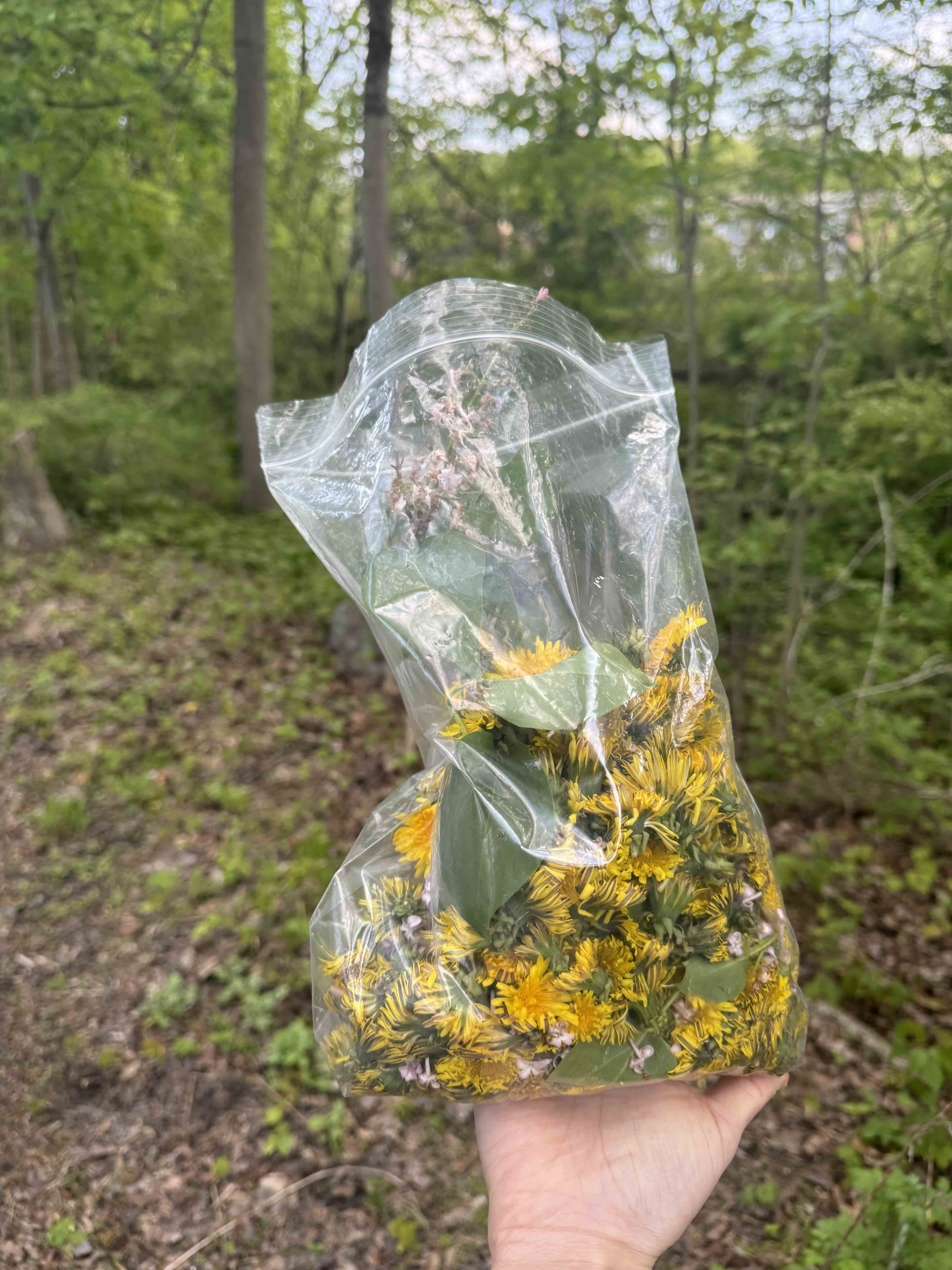
Flowers: The blooms are best picked from mid-spring to summer, and later in the morning when the sun is high and the petals are completely dry of dew. For this recipe, harvest as many flowers as you can, as you will need about 40 to 60 flower heads to fill one cup. If you are unable to find such a large number of dandelions, supplement with other edible flowers (such as bee balm, borage, calendula, chamomile, cornflower, hibiscus, honeysuckle, lilac, rose, or violet).
Cramaillote (Dandelion Honey Preserve)
Ingredients
Preparation
- Carefully pluck the yellow petals from the dandelions to separate them from the green sepals to prevent bitterness. Do this immediately after foraging, as the flower heads will close if left out for a longer time. Do the same for any additional flowers. Rinse the petals well.
- Clean the lemons well and cut them into thick slices.
- Place all the petals, lemon slices, and water in a heavy pot and bring to a boil. Once boiling, turn off the heat and allow the petals and lemon slices to steep overnight, or for eight hours, in order to deepen the flavor.
- Once steeped, strain out the petals and lemons using a cheese cloth or fine mesh strainer and discard.
- Place a small plate or saucer in the freezer, which will later be used to test whether the jam has set.
- Set the remaining liquid in a heavy pot on the stove, adding in the sugar. Bring to a boil, and watch carefully, as it may tend to foam up and boil over.
- Boil for 25 minutes. When the mixture looks as if it would thickly coat the back of a spoon, begin to test for whether the cramaillote has set.
- Place a small dollop of the cramaillote onto a chilled plate and return it to the freezer for two minutes. After two minutes, push the edge of the cramaillote with your finger: if the surface wrinkles and it holds its shape, it is ready. If not, continue to boil and test until it sets on the plate.
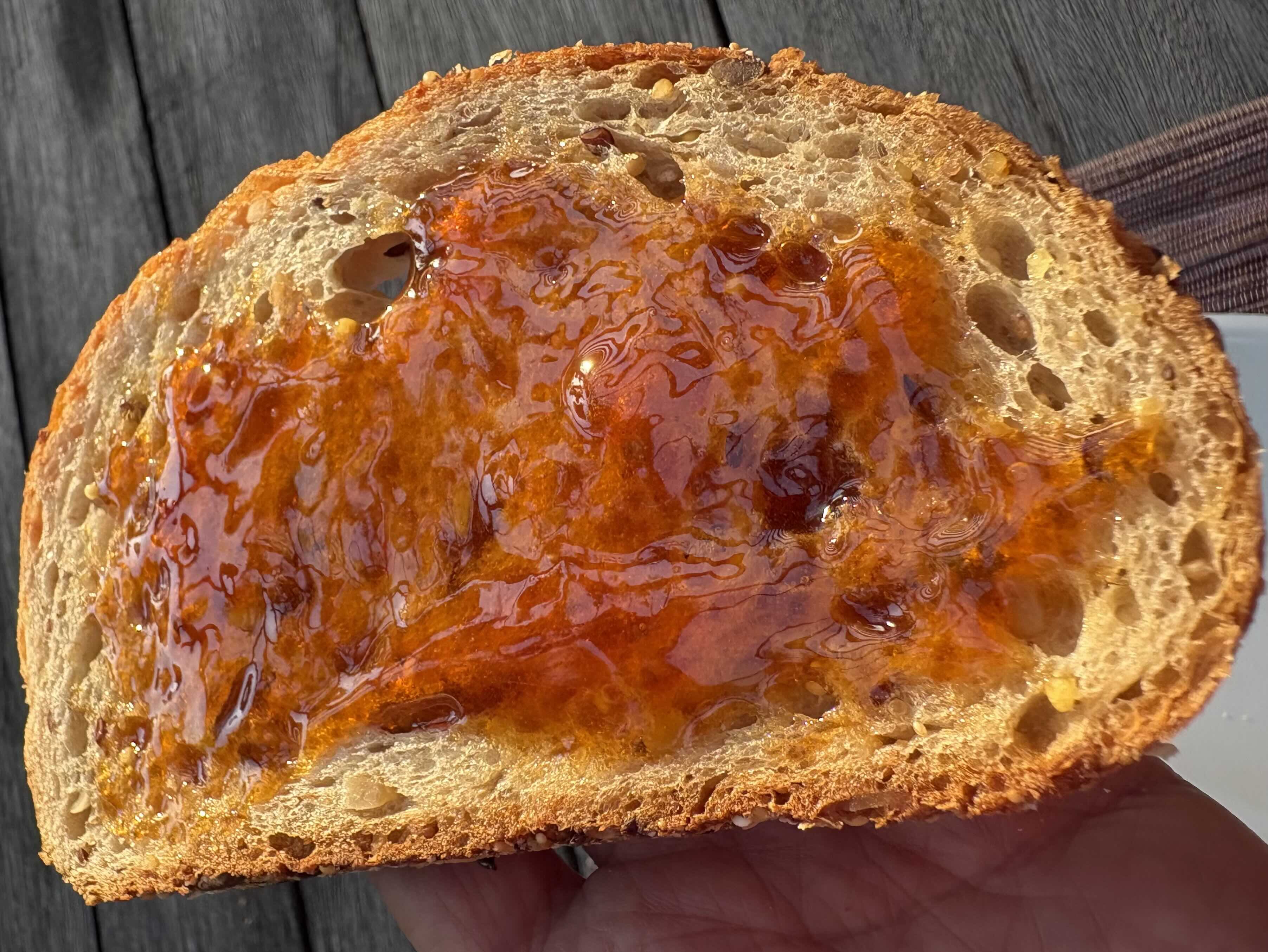
- Once ready, turn off the heat and carefully pour the mixture into a clean glass jar. Allow to cool completely before refrigerating. Enjoy as you would honey or jam.